
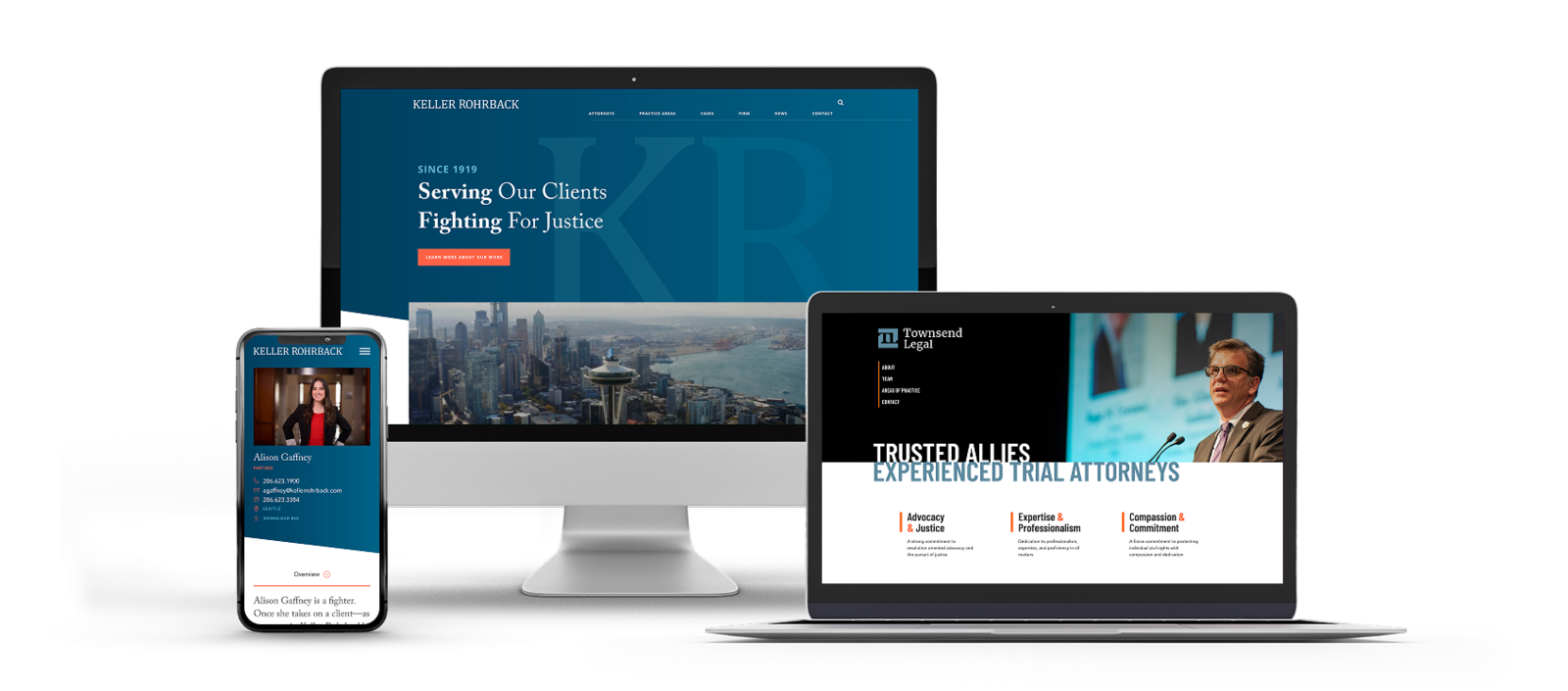
Your law firm's website is often the first impression a prospective client has of your practice. Before they schedule a consultation, they may visit your website to learn about your attorneys, evaluate your experience, and decide whether your firm is the right fit.
In fact, more than one in three potential clients start their search for an attorney online (Clio, 2025). So, having a compelling website can make the difference between contacting you or moving on to contact one of competitors online.
But creating an effective law firm website design is about more than just looking good. It requires an understanding of your clients, your practice areas, your competitive landscape, and the ways people search for legal services.
That's why choosing the right law firm web design agency is an important business decision.
How do you find a website design partner that understands the legal industry and can help your firm grow?
In essence, look for an agency with relevant law firm experience, strong custom design capabilities, a strategic approach to branding, search engine optimization (SEO) and AI optimization, a collaborative process, and a clear plan for maintaining your website after launch.
Here are 8 things to consider before hiring a web design agency for your law firm.
1. Does the Agency Understand How People Choose an Attorney?
Marketing a law firm is different from marketing a restaurant, retail store, or technology company.
People seeking legal representation are often making important decisions under stressful circumstances. They may be dealing with a personal injury, a business dispute, a divorce, or another situation with significant consequences.
They want to know whether your attorneys have the experience, judgment, and commitment to help them.
Your website needs to answer those questions quickly and convincingly.
A good law firm web design agency will take time to understand:
- Your ideal clients: Who are you trying to reach, and what concerns bring them to your website?
- Your practice areas: Which legal services are most important to your firm?
- Your competitive landscape: What distinguishes your practice from other firms?
- Your firm's personality: Should your brand communicate strength and authority, warmth and approachability, or something else?
- Your business goals: Are you looking to attract more clients, pursue different types of cases, recruit attorneys, or strengthen your reputation?
These conversations should happen at the initial kick off, before the design process begins.
2. Does the Agency Create Custom Websites or Use Templates?
There's nothing inherently wrong with a website template. In fact, for some small firms, a template-based website may be a practical starting point.
But firms with established reputations, specialized practices, or ambitious growth plans often need something more distinctive.
Custom law firm website design creates an opportunity to build your firm's identity into every aspect of the visitor experience.
That includes:
- A visual design that reflects your firm's character and positioning
- Messaging that communicates your particular strengths
- Navigation organized around your clients' needs
- Attorney biographies that convey expertise and personality
- Practice-area pages designed for the audiences you want to reach
- Calls to action appropriate to your clients and services
For example, a national class action firm may need a website that communicates its track record in complex litigation and supports extensive content campaigns. A boutique estate planning practice may benefit from a warmer, more personal approach.
Both firms need credibility, but they may express it in very different ways.
3. Can the Agency Help Define Your Law Firm's Brand?
A law firm's brand is much more than its logo.
It's the impression people have of your practice: your expertise, your values, your personality, and the experience clients can expect when working with you.
Your website is one of the most important places where that brand comes to life.
A thoughtful branding process may involve exploring questions such as:
- What do clients value most about working with your attorneys?
- What makes your approach different from competing firms?
- What kind of cases or clients do you want to attract?
- How should people feel when they encounter your firm online?
- Does your current visual identity accurately reflect who you are today?
For established firms, the challenge may be evolving an existing brand without losing the recognition and credibility they've built over time. For newer practices, it may involve developing a distinctive identity from the ground up. Either way, your website should communicate a clear, consistent message.
An agency with expertise in law firm branding, logo design, and website design can help align your visual identity with your broader marketing strategy.
4. Are SEO and AI Optimization Part of the Website Design Process?
A beautiful website won't do much for your firm's growth if prospective clients can't find it.
That's why search engine optimization (SEO) and AI optimization (AIO) should be considered early in the website planning process, rather than treated as afterthoughts.
SEO helps your law firm appear in traditional search engine results, while AI optimization helps make your website's content easier for AI-powered search tools to discover, understand, and potentially reference.
Today, prospective clients may use Google to search for a "Seattle business litigation attorney," but they may also turn to ChatGPT, Perplexity, or Google's AI search features to research legal questions, compare law firms, or find an attorney with specific experience.
An effective digital marketing strategy should consider both types of search behavior.
Building SEO and AI Optimization Into Your Website
At Bizango, SEO and AI optimization are optional services that we highly recommend incorporating into a law firm website project.
Our initial SEO/AIO work establishes a strategic foundation for your new website and typically includes:
- Website SEO audit: Evaluating your existing website's search visibility, technical performance, content, and opportunities for improvement.
- Keyword and search intent research: Identifying the services, questions, and search terms your prospective clients use when looking for legal representation.
- Competitive analysis: Researching how competing law firms position themselves online, which searches they target, and where opportunities exist to differentiate your practice.
- Website content and architecture strategy: Organizing practice-area pages, attorney biographies, location pages, and other content around your firm's business goals and search opportunities.
- On-site SEO optimization: Optimizing page titles, meta descriptions, headings, internal links, and other elements that help search engines understand your website.
- AI search optimization: Structuring content around clear, authoritative answers to relevant questions, establishing signals of expertise and credibility, and making information about your firm easier for AI-powered search systems to interpret.
For law firms redesigning an existing website, this initial work can also include a strategy for preserving valuable search visibility through content evaluation, URL mapping, and redirects.
The goal is to launch with a website that's not only visually compelling and easy to use, but also strategically positioned to compete in traditional and AI-powered search.
Why SEO and AI Optimization Should Continue After Launch
While the initial strategy and on-site optimization provide an important foundation, SEO and AIO are ongoing processes, not one-time projects.
Search algorithms evolve, competitors publish new content, and AI-powered discovery continues to change how people find professional services.
That's why Bizango also offers ongoing SEO and AI optimization services through a monthly retainer.
Depending on your firm's goals, ongoing services may include:
- Monitoring search performance, rankings, and organic traffic
- Developing and optimizing practice-area pages, articles, and FAQs
- Identifying new keyword opportunities and emerging client questions
- Refining content to improve relevance for traditional and AI-powered search
- Evaluating competitor activity and adjusting strategy
- Making technical and on-page SEO improvements
- Monitoring AI search visibility where reliable measurement is available
- Reviewing analytics and recommending improvements based on performance
Ongoing optimization allows your law firm's digital presence to evolve alongside your practice, your competitors, and the changing search landscape.
Although no agency can guarantee specific Google rankings or inclusion in AI-generated answers, a consistent, research-driven strategy can help improve your firm's discoverability and create more opportunities to reach prospective clients.
5. Can the Agency Show Relevant Law Firm Website Design Experience?
An agency's portfolio can tell you a great deal about its capabilities. But don't just look at whether the websites are attractive.
Look for evidence that the agency understands how to translate a firm's business goals into an effective digital experience.
Consider questions such as:
- Does the agency work with firms of different sizes and specialties?
- Do its websites have distinct visual identities?
- Is the content organized around the needs of prospective clients?
- Are attorney credentials and practice areas easy to find?
- Do the websites work well on mobile devices?
- Can the agency explain the business challenges behind its work?
The most valuable case studies explain not only what the agency created, but why.
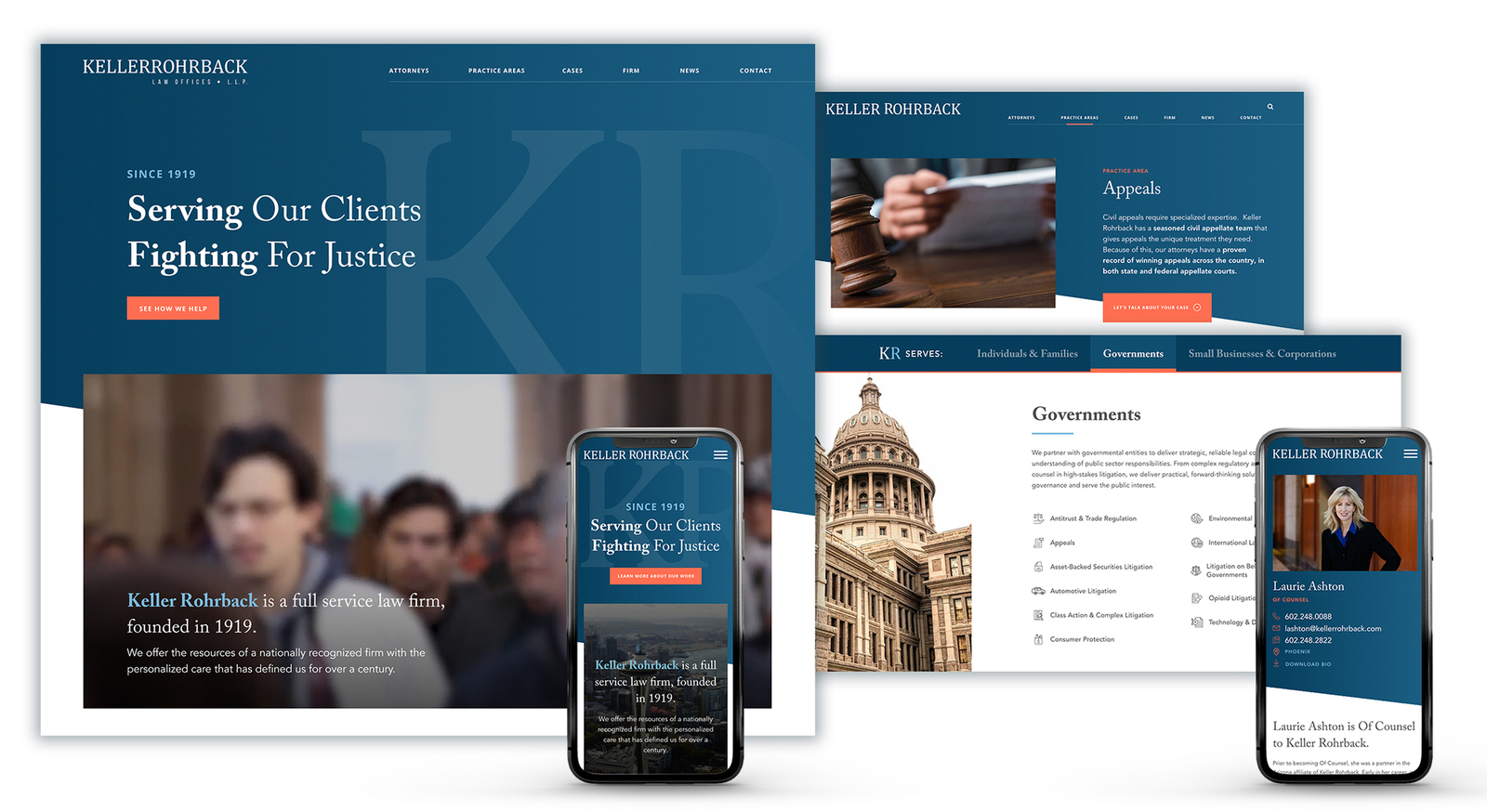
Case Study: Modernizing Keller Rohrback's Online Presence
Seattle-based Keller Rohrback is a nationally recognized law firm representing plaintiffs in complex individual and class action litigation.
The firm's marketing team had an established track record of building awareness around major class action cases. However, its website needed a visual refresh and a more flexible content management system to support its extensive content library and marketing campaigns.
Keller Rohrback partnered with Bizango to design and develop a new modern website that would better support the firm's communications and outreach.
The project involved several important goals:
- Modernizing the firm's visual identity while respecting its long-established reputation
- Creating a more flexible system for managing substantial amounts of content
- Supporting landing pages for high-profile class action cases and marketing initiatives
- Making the firm's online communications easier to manage
- Creating a contemporary design that reflected both its history and the energy of its current leadership
Throughout the project, Bizango collaborated closely with Keller Rohrback's marketing team. The end result: stunning new website that gave the firm a refreshed digital presence and more flexible tools for communicating with prospective clients and supporting its marketing initiatives.
View the Keller Rohrback attorney website design case study.
6. Will the Website Be Easy for Your Team to Update?
Your law firm's website shouldn't become outdated the moment it launches.
Attorneys join or leave the firm. Practice areas evolve. New cases emerge. Your marketing team may need to publish articles, update attorney biographies, or launch new campaigns.
A modern law firm website should make these tasks straightforward.
That's why the content management system (CMS) is an important consideration when selecting a web design agency.
Ask whether your team will be able to:
- Add and update attorney biographies
- Publish articles and news
- Edit practice-area content
- Create landing pages for marketing campaigns
- Update images and other website content
- Manage basic SEO information
Also consider what happens when you need technical assistance.
Does the agency provide training? Is ongoing support available? Will your firm have access to the website's administrative tools? How does the web design agency handle website requests or updates post-launch? And importantly, who owns the website when the project is complete?
7. What Happens After the Website Launches?
Launching a new website is an important milestone, but it shouldn't be the end of your digital marketing strategy.
A website needs ongoing attention to remain useful, secure, and competitive.
Depending on your firm's goals, that may involve:
- Website hosting and technical maintenance
- Security monitoring and software updates
- Search engine optimization
- Content development
- Google Ads or other paid campaigns
- Conversion tracking and analytics
- New practice-area or location pages
- Design and functionality improvements
Not every firm needs every service. A small practice may primarily need dependable maintenance and occasional content updates. A growing regional firm may benefit from an ongoing SEO and content strategy. A national firm with complex marketing campaigns may require more extensive development and digital marketing support.
The important thing is to understand which services the agency offers post-launch, and would they be a long-term partner that can help your website evolve as your needs change or your firm grows.
8. How Will the Agency Measure Success?
An attractive website is valuable, but appearance alone isn't the best measure of success.
Your website should support your firm's business objectives.
For some law firms, that means generating more inquiries from prospective clients. For others, it may mean strengthening referral relationships, recruiting attorneys, or supporting complex marketing campaigns.
Useful performance measures for some projects may include tracking conversions, search traffic or keyword visibility through Google Analytics or Google Search Console, or integrating your CRM with the site to track inquiries and marketing campaigns.
Before starting a project, discuss what success looks like for your firm. A good agency will help establish realistic expectations and meaningful ways to evaluate progress.
What Does a Professional Law Firm Website Cost?
Website pricing varies considerably depending on the size of the firm, the complexity of the project, and the services involved.
A relatively simple website for a solo attorney may require a different investment than a custom website for a multi-office firm with dozens of attorneys and practice areas.
Factors that affect pricing include:
- Custom design and branding requirements
- Number and complexity of website pages
- Content writing and editing
- SEO research and optimization
- Attorney directories and biographies
- Integrations with existing systems or 3rd party platforms
- Accessibility requirements
- Content migration from an existing website
- Custom functionality
- Ongoing hosting, maintenance, and marketing services
At Bizango, custom law firm website projects typically start in the $15,000 range, with many projects ranging from $15,000 to $25,000, depending on scope and branding needs.
When comparing proposals, look beyond the initial price.
A lower-cost website may be relying on a templated design, or limit how much customization is available, or may not include other services that are important to you such as branding, content strategy, SEO, or post-launch support.
Law Firm Website Design Agency: Frequently Asked Questions
Should I hire a web design agency that specializes in law firms?
An agency with law firm experience can bring valuable insight into how prospective clients evaluate attorneys, how legal services should be presented, and which marketing considerations are specific to the profession.
However, industry specialization shouldn't be your only criterion. Evaluate the agency's design quality, strategic capabilities, technical expertise, communication style, and relevant project experience.
The best choice is an agency that understands your firm's goals and has the capabilities to achieve them.
How long does it take to build a law firm website?
A professional law firm website commonly takes approximately 12-16 weeks to design, develop, test, and launch, although larger or more complex projects may take longer.
The timeline depends on the number of custom designed pages are in scope, branding requirements, content readiness, integrations, and the speed of feedback and approvals.
Should SEO be included in a law firm website redesign?
Yes, we recommend SEO be included in the project from the beginning.
A redesign can affect existing search rankings, so your agency should evaluate current website performance, preserve valuable content, plan redirects, and implement appropriate technical SEO practices.
Ongoing SEO services are usually separate from the initial website project.
Can a new law firm website help attract more clients?
A strategically designed website can improve your firm's visibility, credibility, and ability to convert visitors into inquiries.
However, a new design alone doesn't guarantee additional clients. Results depend on factors such as search visibility, competition, content quality, marketing investment, and how effectively your firm handles prospective client inquiries. For a new law firm looking to grow quickly, a ongoing marketing plan that includes SEO, AIO and paid ads are valuable.
What should I prepare before meeting with a law firm web design agency?
Start with your firm's goals, priority practice areas, ideal clients, existing website concerns, and approximate budget.
It also helps to identify websites you like, examples of competitors, and any branding or content you want to preserve.
You don't need to have every detail figured out. A good agency should help you clarify your priorities during the discovery process.
Choosing a Law Firm Web Design Partner Is About More Than Building a Website
Your law firm's website should reflect the quality of your practice and support the future of your business.
That takes more than good design. It takes a thoughtful combination of brand strategy, compelling content, user experience, search optimization, and technical expertise.
When evaluating a law firm web design agency, look for a team that listens carefully, asks good questions, explains its recommendations, and understands how your website fits into your larger marketing goals.
The right partner should help you create a website that not only looks impressive, but also tells your firm's story, builds confidence, and makes it easier for the right clients to find you.
Let's Talk About Your Law Firm's Website
At Bizango, we create custom websites for law firms that want to stand out, communicate their strengths, and connect with the clients they want to serve.
Explore Bizango's attorney website design and SEO services and see how we can help your firm make a stronger impression online.
