
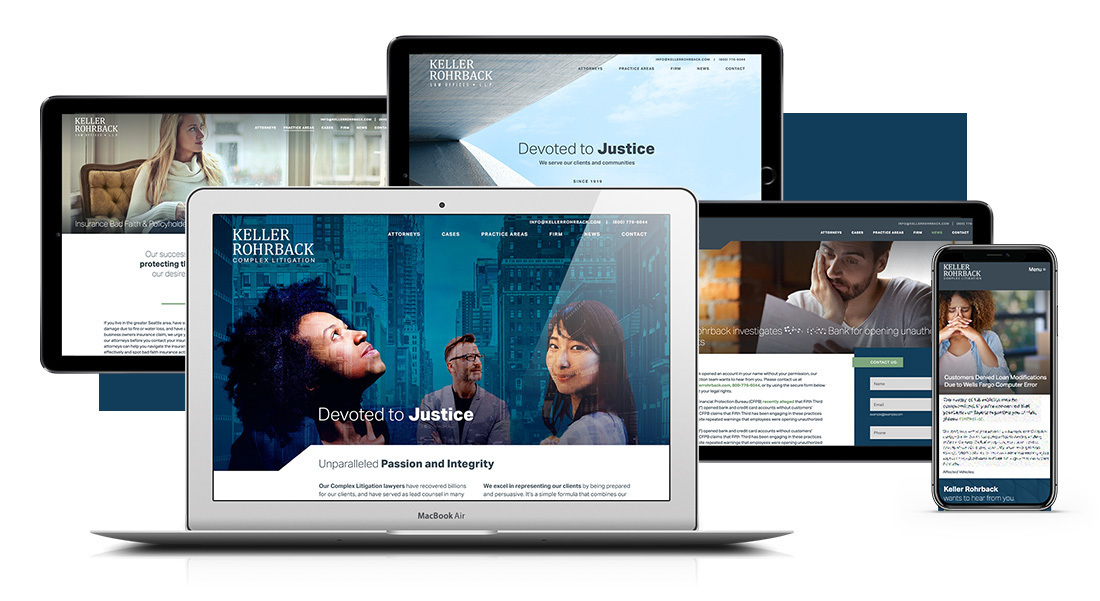
Web Design Best Practices for Law Firms and Attorneys: What Really Matters
May 08, 2026
Updated May 8, 2026
Your law firm’s website is often where people first engage with your practice. First impressions matter. People are judging you in a matter of seconds. What does your website convey to potential clients?
Whether you’re a solo attorney or a full-service legal team, potential clients are judging your credibility, professionalism, and trustworthiness the moment they land on your site. At Bizango, we specialize in professional attorney web design for professionals like you, and we know what truly makes a law firm website stand out and convert.
Here are the best law firm website design practices you should follow to ensure potential clients are not only finding you, but they are clicking to contact you about their case.
1. Professional Web Design That Builds Trust
Your website needs to reflect your firm’s authority and professionalism. A poorly designed or outdated site can make even the most capable firm look unreliable.
First impressions are everything, especially in the legal field where trust and authority are paramount. A well-designed attorney website can convey professionalism, credibility, and attention to detail—the very qualities clients look for in an attorney. On the other hand, an outdated or amateur-looking site may raise doubts about your competence or success. Law is a high-stakes industry, and your website should reflect the level of care and expertise you bring to every client interaction. It’s not just about looking good. It’s about inspiring confidence and standing out among tough competitors.
For web design best practices, we recommend:
- A clean, modern layout with high-quality images and professional photos of attorneys, team members and of the office
- Strong branding and consistent use of fonts and color palette
- Prominent display of credentials, awards, and affiliations
- Clear, intuitive navigation
- Strong calls to action placed strategically throughout the site
- Clear branded messaging that focuses on client outcomes and your firm’s differentiators
2. Clear Navigation and Structure
Clients often come to law firm websites with specific questions or needs. If they can't find the information they are looking for quickly, they'll leave.
When someone visits a law firm’s website, they’re often feeling overwhelmed, under pressure, or unsure what to do. Whether they’re facing a lawsuit, planning an estate, or dealing with a family matter, they need answers quickly and to trust that they’ve come to the right place for answers. If your website is difficult to navigate, they may leave before they even find your contact information. Having a well organized, easy to navigate site helps prospective clients find what they need without frustration. Good navigation is essential because it directly impacts your site visitor’s experience, which is often the first contact they have with your firm.
Benefits of a well organized site and clear navigation:
- Site visitors that can find information quickly and easily are more likely to stay on your site.
- It increases visitor engagement and makes the steps to connect with your firm feel intuitive.
- Visitors that can easily navigate a site are more likely to convert or click to contact you.
- An organized navigation signals competence and attention to detail. This helps to create trust.
- A well structured navigation is important for your SEO performance.
It is important to limit the top-level navigation items. Prioritize the menu based on categories such as ‘attorneys’, ‘areas of practice’, etc. Too many top-level items will look cluttered and feel overwhelming to your visitors. Using a dropdown navigation helps keep things organized, but its best to keep it to one-tier and avoid nested or 3rd-level navigation. For large or complex sites, you may consider a mega menu or integrating a search function so that visitors can more easily find what they are looking for.
3. Responsive Web Design
According to Google, most searches are conducted on mobile devices. It is estimated that 60-65% of web traffic is on mobile. It is therefore safe to say that many of your potential clients are looking at your site on their phone. Having a site that not only looks good on mobile, but performs well and loads quickly is essential.
Having a responsive site that is optimized for mobile is also important in SEO. Google penalizes slow or non-responsive sites in search rankings. A mobile-optimized, fast-loading site ensures you’re making a strong first impression no matter where or how a client finds you.
For mobile design best practices, we recommend:
- Keep the navigation simple in a hamburger style menu, with easy to tap navigation items.
- Ensure text is easy to read with clear fonts and strong contrast.
- Optimize for page load speed by doing things such as compressing images and minimizing code.
- Make calls to action bold and easily clickable.
- Have short paragraphs, bulleted lists and clear headlines for easy readability. Search engines like this, too.
4. SEO/AI Optimization
Once you build your website, how will potential clients find you? Strong search engine optimization and AI optimization ensures you're visible to clients searching for legal help.
Traditional SEO helps your firm appear at the top of Google search results when someone searches on your keywords, for example terms like “divorce lawyer near me” or “Seattle criminal defense attorney.” There are many onsite and off-site strategies to improve your site’s rankings.
As an SEO agency, these are some of the strategies we recommend:
- Start with keyword research and competitive analysis. Knowing the words that your target audience is searching on and how your closest competitors are ranking is the backbone for any SEO strategy.
- Optimize your site’s title tags, meta data and h1s.
- Pay attention to page speed and technical performance
- Create quality, informative content that address common legal questions and demonstrates your expertise. Make sure your content is regularly updated.
- To help with local rankings, optimize your Google Business Profile and get reviews.
- Grow your citations in directories and earn high-quality backlinks.
As search behavior evolves, law firms are no longer optimizing solely for traditional search engines. They also need to consider how they appear in AI searches such as ChatGPT, Google AI Overview, Perplexity, etc. Increasing your visibility in AI search requires more than basic SEO; it means creating trustworthy, well-structured, authoritative content that AI systems can easily understand, reference and display in response to user questions.
Here are some things we recommend for better AI visibility:
- Write in natural language. The content on your site should be clear and written with a human touch, answering the kinds of questions your clients ask. FAQ style format is an excellent way to include the information that people want to know, in a way that is easily digestible and is more likely to surface in AI search queries.
- Structure your content with headlines, bulleted lists and a clear hierarchy which makes it easy to read.
- Implement the correct schema markup on the pages of your site. This code on the backend of your site helps search engines better understand your business and what you are about.
- Include trust signals on your site such as author bios, awards or accreditations and testimonials.
- Build your brand authority through backlinks, PR mentions, or reviews.
By combining strong technical SEO, clear content organization, topical expertise, and brand credibility, law firms can improve their chances of being discovered not only in search rankings, but also in the growing ecosystem of AI searches.
5. Strong Calls-to-Action (CTAs)
Beautiful web design doesn’t drive leads unless it guides users toward taking the next step.
Without clear direction, even the most interested visitor may leave your site without taking action. A strong call-to-action guides users toward the next step, whether that’s scheduling a consultation, making a phone call, or filling out a contact form. Effective CTAs remove friction from the decision-making process and make it easy for prospective clients to reach out. In the competitive legal field where potential clients are checking out your competitors’ sites, this clarity can make all the difference.
Best practices for CTAs:
- Contact forms are short and easy to complete
- Click-to-call phone numbers on mobile
- Strategically placed CTAs throughout the site
7. ADA Accessibility Websites
It is best practice for legal websites to comply with accessibility standards.
Having a website that is accessible ensures that everyone, including users with disabilities, can perceive, navigate, understand and interact with your site. An accessible website can improve the user experience not only for people with disabilities, but for older site visitors, or those on mobile devices, too.
Here are the different levels of website accessibility as defined by WCAG (Web Content Accessibility Guidelines):
A - Minimum level for accessible web content. This level affects the broadest group with the most benefits.
AA - More accessible web content. This level should work with most assistive technology.
AAA - Most comprehensive and stringent level. This is reserved for specialized content or organizations and is not generally required.
If accessibility is included in the scope of the project, it is important to know what level of accessibility we are designing for from the very beginning. Accessibility guidelines effect every aspect of the website creation.
Some examples of accessibility practices:
- Have informative and concise page titles and headings
- Include descriptive alt text on images and graphics
- Incorporate high contrast colors especially for links and text
- Fonts and line spacing should be easily readable
- Forms should have visible labels and required fields should include an error message
Key Elements Every Attorney Website Should Include
Beyond having a stunning law firm web design, the content and features of your website are what ultimately convert visitors into clients. Law firm websites should be tailored to inform, engage, and establish trust. Here are the must-have elements we recommend for every attorney website:
Attorney Bio Pages
Your bio is often one of the most visited pages on your site. Potential clients want to know who they’ll be working with—not just your credentials, but also your approach and personality. A compelling attorney bio should include a professional headshot and details about your education, areas of practice, professional achievements, and a short narrative that humanizes you and highlights your dedication to client service.
Practice Area Pages
Clearly defined service pages help users (and search engines) understand what you do. Each area of practice—such as personal injury, criminal defense, estate planning, or corporate law—should have its own page with detailed, helpful content. These pages not only improve SEO but also demonstrate your firm’s depth of knowledge and reassure clients that they’ve come to the right place.
Case Results and Testimonials
Nothing builds confidence like proof. A section highlighting successful case outcomes shows that your firm gets results and client testimonials go a long way to boost credibility and trust. Take precautions to not reveal confidential information and get clients' written consent for testimonials.
Contact and Consultation Forms
Your website should make it easy for clients to get in touch with you. Every page should have a clear path to contact, whether it’s a brief form, a phone number, or a “Request a Consultation” CTA.
Legal Blog or Resource Page
Publishing informative articles on common legal questions can position you as an expert in your field and improve your website’s SEO and AI visibility. Blogs are also a great way to address timely topics or changes in the law that affect your clients.
Law Firm Web Design FAQ
Why is professional web design important for law firms?
Having a professional web design is important for law firms to appeal to potential clients. It helps build credibility and establish trust and for many potential clients, a law firm’s website is the first impression of the practice. A professionally designed attorney website improves the site visitors’ experience, clearly communicates legal services, highlights attorney expertise, and guides visitors toward contacting the firm. It also supports search engine optimization (SEO), mobile responsiveness, accessibility compliance, and faster load times — all of which impact visibility and client acquisition. For law firms competing in crowded markets, strong web design is often a key differentiator.
What Makes a Good Law Firm Website?
A top law firm website combines professionalism, clarity, and usability. Site visitors should immediately understand:
- What areas of law the firm practices
- Who the attorneys are
- Where the firm is located
- How to contact the office
The best law firm websites balance strong branding with practical functionality and information that helps potential clients take action.
How Much Does a Law Firm Website Cost?
The cost of a law firm website depends on the size, functionality, and customization required. Other considerations are if logo and branding or SEO optimization are included in the scope of the project.
Typical ranges include:
- Basic template website, typically 1-3 page site: $2,000–$5,000
- Custom professional website, typically 5-25 page site: $8,000–$25,000+
- Enterprise/large firm or multi-location firms: $25,000–$80,000+
Initial costs may include:
- Custom web design
- Customized development or enhanced functionality
- Content writing
- SEO audit, research, strategy and onsite optimization
- Photography or video
- Targeted landing pages such as for practice areas
- CMS integration
- Dedicated project management
- Launch assistance
To maximize your investment, law firms should view their website as a long-term marketing tool rather than simply a digital brochure. Budgeting for ongoing maintenance and monthly SEO/AIO retainers are generally separate from the initial costs, but should be factored into your marketing plan.
How Can a Law Firm Website Generate More Leads?
A law firm website generates leads by attracting potential clients, gaining their trust, and making it easy for them to find information and take action. An effective website should function as an active marketing tool and not just pretty pictures.
Key lead-generation strategies include:
- Clear calls-to-action
- SEO / AIO focused content
- Practice-area landing pages
- Fast, mobile-friendly design
- Contact forms on every key page
- Trust signals like reviews and awards
- SEO onsite optimizations and offsite campaigns
- Informational articles that address the questions your clients have
Why Is SEO / AIO Important for Law Firm Websites?
SEO helps law firms appear in search results when potential clients are looking for legal services online.
Law firm SEO generally includes:
- Initial audit, keyword research and competitive analysis
- Keyword-focused practice area pages
- Technical website optimization
- Content creation
- Internal linking
- Local SEO optimization
- Fast load times and mobile usability
For many firms, SEO is a necessary investment. Without an SEO strategy, even a visually impressive website may struggle to be found online. Law firm SEO is a highly competitive market and to keep pace or to outrank your closest competitors usually requires ongoing efforts.
Why Work with a Web Design Agency That Understands Law Firms?
At Bizango, we bring 20+ years of experience designing high-converting websites for attorneys and law firms. We know what drives legal clients to pick up the phone—and how to showcase your firm as the trusted choice.
From custom branding and logo design to ongoing SEO/AIO and website maintenance, we offer full-service digital marketing solutions tailored to the legal industry. Whether you're rebranding, launching a new firm, or upgrading your current site, we build websites that deliver measurable ROI.
Ready to elevate your law firm’s online presence?
Let’s talk. Contact Seattle attorney website specialists Bizango today to get started on a website that works as hard as you do.
